DCOF, or Dynamic Coefficient of Friction, provides a numerical result from a controlled test to describe a tile surface’s resistance to sliding under specific conditions. It gives measurable information that appearance alone cannot provide.
A tile should not be judged as slip-resistant simply because it looks rough, matte or textured. Surface finish, texture and water can affect how the tile performs, so the actual surface needs to be evaluated using a defined test method. Understanding the tile slip resistance science behind DCOF, slip testing and surface processing helps you choose a floor tile based on measured performance rather than appearance or marketing claims.
Tile Slip Resistance & DCOF Safety Audit
Calculate the required DCOF rating, slip rating, and finish based on your specific traffic and moisture conditions.
1. What is the expected moisture exposure in the installation zone?
Table of Contents
- Tile Surface Texture and Water: Why One Floor Tile Has More Grip Than Another
- DCOF Measures How Much a Tile Resists Sliding Under a Specific Testing Condition
- How a Laboratory Tests Tile Slip Resistance and Produces a DCOF Result
- DCOF, R Ratings, and PTV: Understanding Different Slip Measurement Systems
- How Tile Manufacturing and Surface Processing Change Slip Resistance
- Why a Tile Slip-Resistance Test Report and Certificate Are Essential Before You Buy
- How to Choose a Slip-Resistant Floor Tile by Matching Test Results to Real Applications
- Porcelain Tile Is Not Automatically Slip-Resistant: Surface Matters More Than Name
- Five Simple Questions to Ask a Tile Manufacturer Before Specifying Floor Tiles
- Final Thoughts: Good Slip-Resistance Decisions Begin With Science
Tile Surface Texture and Water Together Help Explain Why One Floor Tile Has More Grip Than Another
When studying tile slip resistance science, friction on a tiled surface is governed by the microscopic physical interaction between footwear outsoles and the tile’s surface profile.
Microtexture: Tiny Features on the Tile Surface
Microtexture means very small surface features that may not be visible to your eyes. Even though they are microscopic, these tiny peaks (asperities) penetrate fluid films and create real contact area with the shoe sole, determining the fundamental friction limit.
Surface Texture: Larger Features You Can See and Feel
Surface texture refers to more noticeable raised, lowered or structured features. These can change the contact between the tile and footwear, help channel water away from the contact plane, and influence physical grip.
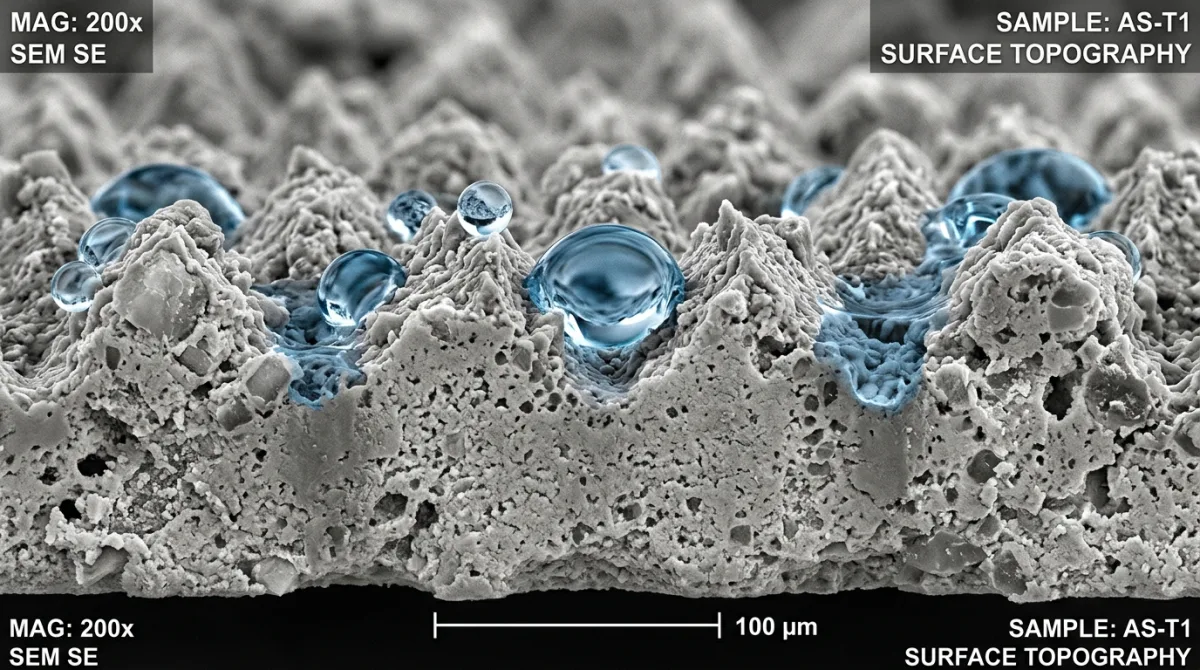
Water: Why Wet Conditions Change Tile Grip
Water can form a continuous hydrodynamic lubricating layer between the tile and the foot or shoe. When a person steps on a wet floor, the fluid must be displaced in milliseconds. If the surface lacks microtexture to penetrate this hydrodynamic squeeze film, hydroplaning occurs, which is why a tile can behave drastically differently when wet than when dry.
Surface Finish: Why Polished, Matte and Structured Tiles Differ
Polished, matte tiles, and structured finishes have vastly different surface characteristics. Highly polished surfaces exhibit high dry friction due to adhesion, but their smooth profile allows water films to eliminate mechanical interlock when wet. Conversely, structured anti-slip tiles maintain mechanical grip even under heavy fluid contamination. However, the finish name alone does not tell you the actual tested slip resistance.
📥 Download the Ramirro Ceramica DCOF & Slip Safety Technical Guide
Access calibrated laboratory test certificates, ANSI A326.3 compliance documents, and R-rating charts across our complete commercial porcelain tile catalog.
DCOF Measures How Much a Tile Resists Sliding Under a Specific Testing Condition
In tile slip resistance science, DCOF stands for Dynamic Coefficient of Friction. It is a numerical measurement that describes a tile surface’s resistance to sliding under defined test conditions.
What Does “Dynamic” Mean?
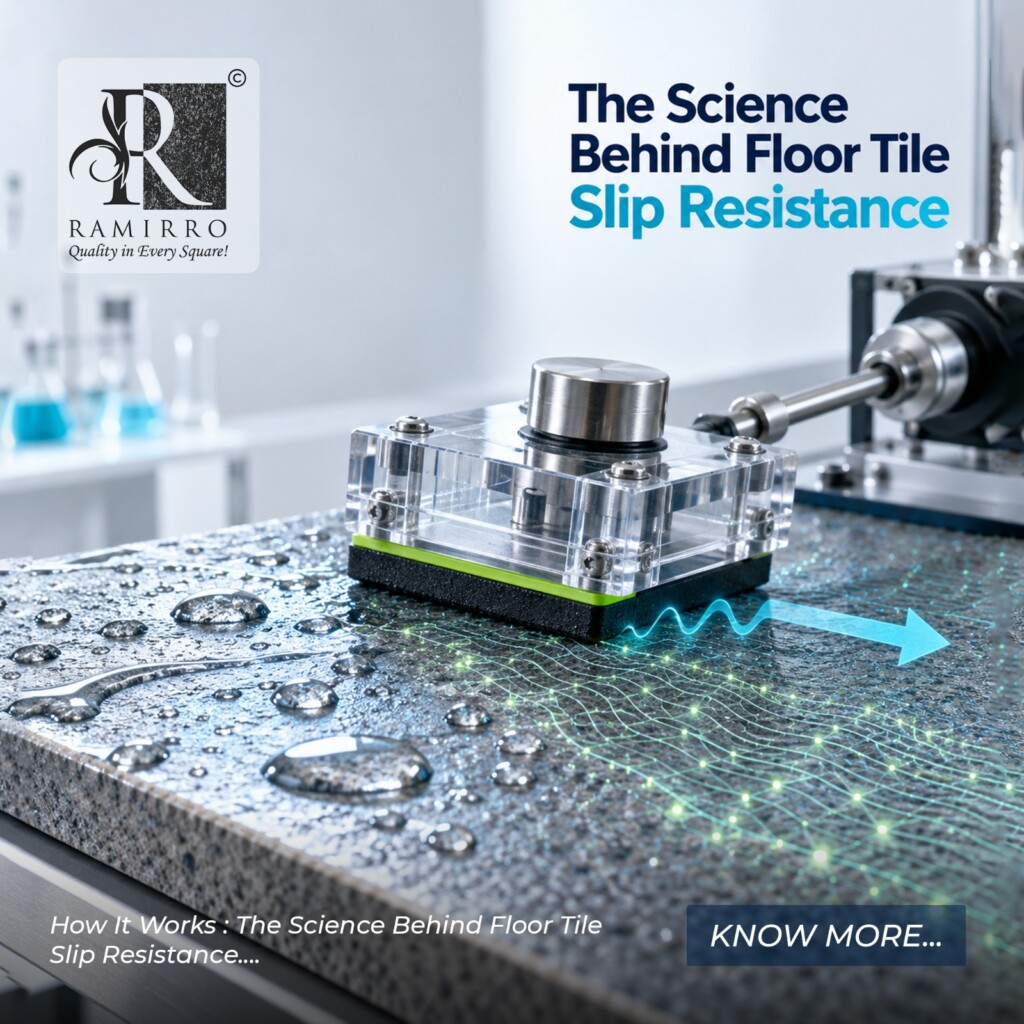
Dynamic means movement is already taking place. During a DCOF test, a standardized sensor moves across the tile surface at a controlled speed, allowing the instrument to measure kinetic resistance while motion is occurring, closely simulating a slipping foot.
What Does “Coefficient of Friction” Mean?
Friction is the physical resistance between two surfaces when one slides across the other. The coefficient (μ) is the dimensionless ratio of horizontal friction force to vertical normal load (μ = F / N) used to express that measured resistance.
What Does a DCOF Result Actually Tell You?
In North America, the ANSI A137.1 / ANSI A326.3 standard specifies a minimum wet DCOF threshold of 0.42 for level interior spaces expected to be walked on when wet. A DCOF result shows how the tile performed under that specific laboratory protocol. It is critical for evaluating slip resistance, but it is not a blanket guarantee of absolute safety under all slope, contamination, and footwear conditions.
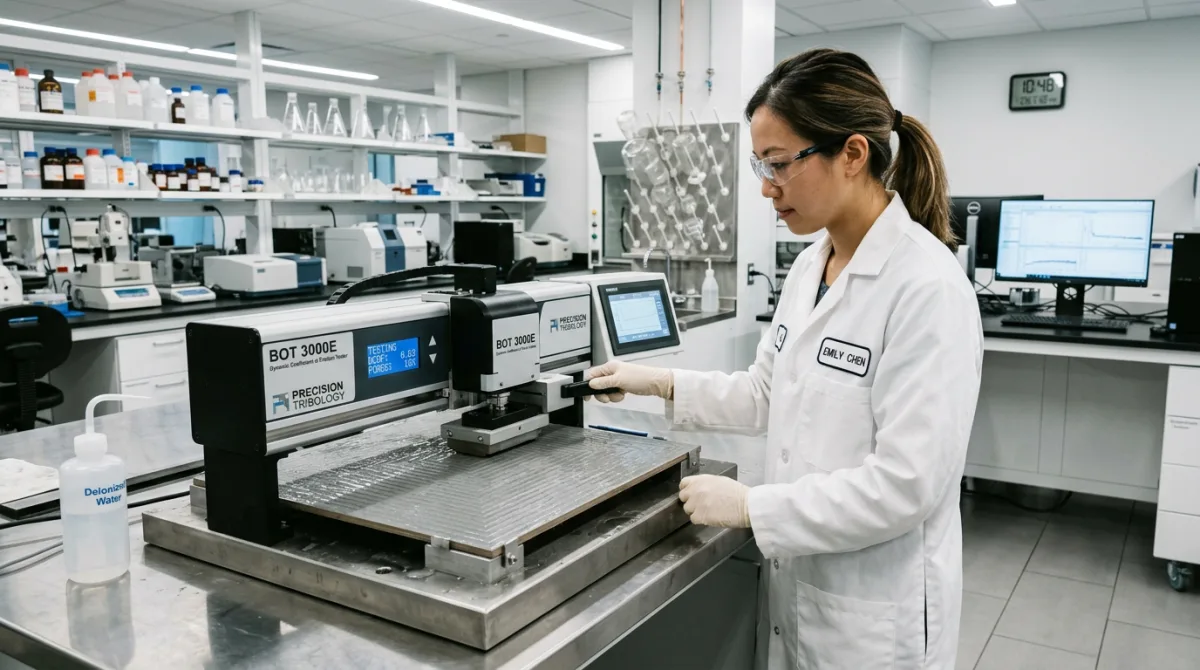
How a Laboratory Tests Tile Slip Resistance and Produces a DCOF Result
A core principle in tile slip resistance science is that a DCOF result comes from an accredited laboratory test, not from tactile guesswork. Understanding the test protocol ensures engineering specifications are respected.
- The Tile Sample: Multiple representative tiles from production runs are calibrated and leveled on a rigid test bed.
- The Test Equipment: Automated tribometers (such as the BOT-3000E) pull a standardized SBR (Styrene Butadiene Rubber) sensor across the tile surface under a continuous, regulated normal load.
- The Test Liquid and Conditions: A standardized wetting solution (0.05% Sodium Lauryl Sulfate aqueous solution) is applied to simulate soapy water surface tension and test wet sliding friction.
- Measuring Friction: High-precision load cells measure resistance over 200 mm to 500 mm travel distances.
- The Final Result: Three to four directional passes are averaged to produce the certified DCOF rating value.
🧪 Request Slip-Resistance Physical Tile Sample Kits
Evaluate real tactile grip, sugar finishes, and certified R10/R11 textured surfaces under your local facility lighting and liquid conditions.
DCOF, R Ratings, and PTV: Understanding Different Slip Measurement Systems
Tile slip resistance science uses different testing methodologies across international markets. Treating these numbers as interchangeable is a frequent engineering error.
| Testing System | Test Apparatus / Standard | Measurement Principle | Typical Benchmark Ranges |
|---|---|---|---|
| DCOF | ANSI A326.3 / BOT-3000E | Dynamic horizontal friction with wet SBR rubber slider | ≥ 0.42 for wet level interior floors |
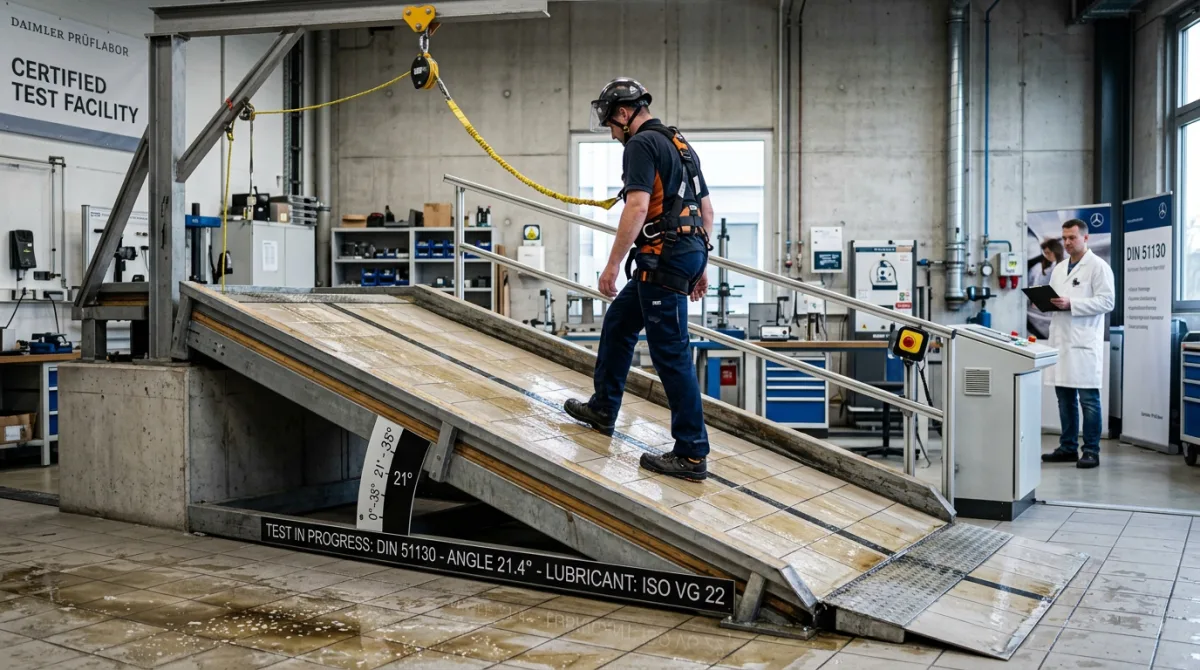
| R Rating | DIN 51130 (Germany / Europe) | Human operator in boots walking an oil-coated inclined ramp | R9 (6°–10°) up to R13 (> 35°) |
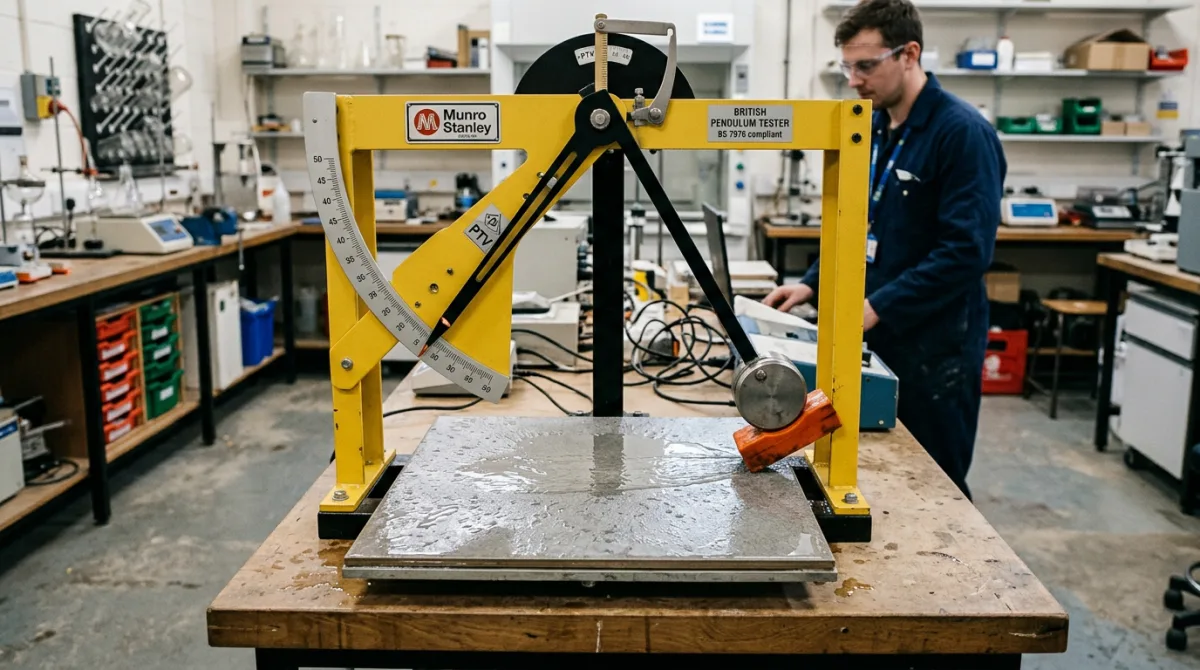
| PTV (Pendulum) | BS 7976-2 / EN 16165 | Swinging pendulum arm with rubber slider over wet tile | PTV 0–24 (High risk), 25–35 (Moderate), 36+ (Low slip risk) |
An R rating cannot simply be converted mathematically into a DCOF value because the test conditions (inclined ramp with motor oil vs. flat travel with aqueous surfactant) evaluate different friction regimes. Always specify by the standard required in your local jurisdiction.
How Tile Manufacturing and Surface Processing Change Slip Resistance
Applying tile slip resistance science during manufacturing enables factories to engineer friction through specialized mineral formulations, glaze chemistry, and surface texturing.
- Glazing Chemistry: Incorporating hard corundum or silica micro-granules into the protective glaze increases microscopic friction without compromising stain cleanability.
- Polishing and Honing: Polishing shears away all microtexture peaks to produce mirror-like gloss, significantly lowering wet friction. Honing leaves a satin, smooth finish with intermediate slip characteristics.
- Structural Press Molds: Punch dies create macroscopic relief (stone textures, wood grain, anti-skid ribs) that mechanically interlock with shoe soles and facilitate liquid drainage.
- Sugar & Carving Finishes: Innovative technical applications (such as Ramirro’s Sugar finish) introduce tactile micro-crystallites that yield R11 slip safety with comfortable barefoot touch.
Why a Tile Slip-Resistance Test Report and Certificate Are Essential Before You Buy
A certified test report provides traceable verification from an accredited testing institute. When reviewing certificates, verify:
- Exact Product & Caliber Match: Ensure the test applies to the exact batch, glaze, and finish being ordered, rather than an unrelated item in the collection.
- Referenced Standard: Verify whether ANSI A326.3, DIN 51130, or EN 16165 was executed.
- Wet vs. Dry Data: Confirm the wet coefficient of friction value, which dictates real-world slip safety.
- Accredited Testing Body: Look for testing from recognized ceramic testing laboratories (TCNA, Lucideon, or certified in-house QA laboratories).
How to Choose a Slip-Resistant Floor Tile by Matching Test Results to Real Applications
Through the lens of tile slip resistance science, choosing the right floor tile is about matching tested friction metrics directly to the real-world environment:
- Commercial Entrances & Foyers: High foot traffic transitioning from rain requires DCOF ≥ 0.42 to 0.50 with walk-off matting.
- Commercial Kitchens & Food Prep: Heavy grease and fluid contamination require R11 to R12 ratings with structured profiles.
- Bathrooms & Wet Rooms: Floor surfaces require anti-slip matte porcelain with DCOF ≥ 0.42 or PTV ≥ 36.
- Swimming Pool Decks & Patios: Exterior outdoor environments require R11 / Sugar finish porcelain tiles resistant to algae, UV, and frost.
💼 Commercial Project Specification & Container Export Consulting
Collaborate with Ramirro Ceramica’s technical engineers for slip-safety compliance reviews, customized DCOF batch certifications, and direct container export logistics.
Porcelain Tile Is Not Automatically Slip-Resistant: Surface Matters More Than Name
A common misconception is that porcelain tile is inherently slip-resistant. “Porcelain” defines the density, vitrification, and water absorption (≤ 0.5%) of the tile body, not its surface traction.
A polished porcelain tile and a structured anti-slip vitrified tile share the same dense ceramic body, yet perform at opposite ends of the friction spectrum under wet conditions. Never specify porcelain for wet floors without confirming the surface finish and DCOF test report.
Five Simple Questions to Ask a Tile Manufacturer Before Specifying Floor Tiles
Before purchasing or specifying floor tiles for your project, ask the manufacturer these five essential questions:
- What slip-resistance test method was performed? (DCOF ANSI A326.3, DIN 51130 ramp, or PTV pendulum?)
- What was the measured wet friction result? (Does it satisfy the minimum safety criteria for the space?)
- Does this test certificate apply to this exact batch and surface finish?
- What is the recommended cleaning protocol to prevent grease or soap scum buildup from reducing friction over time?
- Is the tile rated for exterior, freeze-thaw, or barefoot wet applications?
Final Thoughts: Good Slip-Resistance Decisions Begin With Science
As demonstrated by tile slip resistance science, floor traction is not determined by appearance alone. The interaction of texture and material, wet and dry conditions, and dynamic friction explains why floor tiles perform differently. DCOF and other slip resistance ratings provide the verifiable scientific evidence required to protect pedestrians and prevent costly slip accidents in residential and commercial spaces.
Ramirro Ceramica manufactures a comprehensive range of tested, certified slip-resistant porcelain and ceramic tiles engineered for global architects, developers, and homeowners. Explore our latest collection online or contact our technical engineering team to select the safest surface for your next architectural project.
Watch our Video:
Shop Now | Chat With Expert | View Catalogue

Here’s what you get out of our article. Our team have various Ceramic Experts with experience of more than 25 Years, researches on problems our customer faces in tiling industry.
Ramirro Ceramica, – One of The Leading Tiles Manufacturer and Supplier globally, helps you people gain knowledgeable insight before making your purchase decision for products related to the floor and wall tiles.
So, we have closely monitored all kinds of trends in the ceramic tiles manufacturing world, from the old days of clay and plain color to modern digital, realistic-looking designs printed on ceramics with high-depth effects.
Our tiling Experts have seen thousands of different tiles patterns, sizes, materials, pricing, and installation techniques throughout their career.
Their expertise shared with you in simplified and organised way, helps you choose and make better decision before purchasing any flooring option available in market.
Brief about Company:
Ramirro is one of the finest Tiles manufacturers in India manufacturing porcelain and ceramic tiles. Our products have a variety of sizes and types of tiles ranging from Ceramics, porcelain, Full body etc. This helps you choose the perfect fit for your project. Plus, our collection will help you get inspiration from the architect’s design.
Here’s some more helpful links that showcase our users trust on Ramirro Ceramica Brand:
– Growth in International Market
– Trusted and Licensed Exporter
– Manufacturing Plant in India
Here’s our social proof by LinkedIn competing with top known global tiling brands: