Two tiles can have the same size and still have very different prices. Why? Because mastering tile pricing economics for buyers depends on much more than the raw material used to make the tile.
Fuel, electricity, glaze, digital printing, labour, design, packaging, transport, and other production costs can all affect the final tile price. Even installation and delivery can change the true cost of a tile floor.
That is why the price on a quotation is not always the complete project cost. Understanding these hidden factors within tile pricing economics for buyers helps you compare tiles properly, avoid false savings, and choose the right tile for your project.
Interactive True Tile Cost & Hidden Economics Estimator
Calculate your real expenditure by uncovering hidden costs behind tile pricing economics for buyers—including adhesive, wastage, labor, freight, and Incoterms.
1. What is the scope and setting of your tile installation project?
Table of Contents: Tile Pricing Economics for Buyers
- What Really Goes Into the Price of a Tile?
- From Fuel and Electricity to Glaze and Ink: The Costs Behind Production
- Why More Designs, Better Finishes and Custom Collections Can Cost More
- The Price Doesn’t Stop at the Factory Gate
- FOB vs CIF: Why the Quote Can Be Confusing
- How to Calculate the True Cost Before Buying Tiles
- How Smart Buyers Compare Tile Prices
- The Cheapest Tile Is Not Always the Cheapest Choice
- Final Takeaway — Look Beyond the Tile Price
- Frequently Asked Questions (FAQs)

What Really Goes Into the Price of a Tile?
A tile may look simple, but its price starts with the materials and process used to make it. Ceramic, porcelain, and vitrified tiles can have different compositions and manufacturing requirements. Common tile-making materials include clay, feldspar, and quartz. Feldspar helps the tile body melt during firing, while quartz helps provide structure and stability. The exact mix and production method can vary by tile type.
The size, thickness, and surface also affect the cost. A standard tile with a simple matte surface may need fewer production steps than a thicker tile with a polished, textured, or highly detailed surface. Larger formats can also require more careful handling and production control.
Think about a simple plain tile compared with a detailed marble-look tile. Both may be the same size, but the marble-look tile may involve more design work, digital printing, glaze, surface development, and quality checks. So when you evaluate tile pricing economics for buyers, you are not only paying for the tile itself. You are paying for everything required to create its size, body, appearance, and performance.

From Fuel and Electricity to Glaze and Ink: The Costs Behind Production
A tile may sit quietly on your floor, but its price has already travelled through a long list of costs. Clay, feldspar, quartz and other minerals must be mined, processed and moved to the factory. If raw material or transport costs rise, the tile price can feel the impact.
Then comes the factory itself. Electricity, gas or other fuels, labour, rent and maintenance all keep production moving. Even the beautiful surface you see has a cost. Glaze, digital printing and specialised inks can add to the manufacturing bill, especially when some materials are sourced internationally.
Here is the part buyers often miss: a cheaper tile does not always mean a better deal. A manufacturer can reduce costs through better efficiency, but cutting too deeply in the wrong areas may affect consistency, finish, packaging or performance. So instead of asking only, “Why is this tile cheaper?” ask, “What is behind the lower price?”
Why More Designs, Better Finishes and Custom Collections Can Cost More
More choice sounds great when you are buying tiles. But have you ever wondered what it costs a manufacturer to keep all those choices available?
- A design starts before production: Designers spend time creating patterns, colours, textures and new collections. Some designs also need several trials before approval.
- Details can add cost: Marble look, stone look and other detailed designs may use digital printing, special inks, glaze and additional surface work.
- Size and thickness matter: Changing the tile size or thickness can change material use, production settings, handling and packaging requirements.
- Every finish has a process: Matte, polished, textured and other surfaces may require different treatments or additional production steps.
- Samples are not free: Some buyers want to touch and see tiles rather than select them from a PDF. Physical samples, display boards and sample boxes all require production, packing and storage.
- Slow moving designs tie up money: A design that sells slowly can remain in the warehouse for months, taking up space and tying up inventory investment.
The interesting part? More designs give buyers more freedom, but they also create more costs behind the scenes. So when you see a huge tile collection, remember: every extra choice has an economic story behind it.
Request an Itemized Factory-Direct Tile Cost Estimate
Get transparent, unbundled pricing covering tile production, export packaging, palletization, and FOB/CIF freight calculations from Ramirro Ceramica.
The Price Doesn’t Stop at the Factory Gate
The tile is ready. The price isn't.
Once tiles leave the factory, they begin another journey: Factory → Truck → Port → Ship → Destination → Buyer. And every step can add a cost.
Packaging protects the investment: Tiles need strong cartons, separators, plastic protection, pallets and other materials to reduce damage during a long journey. Better protection can cost more, but replacing broken tiles costs even more.
Handling can create hidden losses: Tiles may crack or chip during loading, unloading, stacking or transportation. Poor handling or negligence can turn a finished product into a direct loss.
Getting to the port costs money: Factory-to-port transport involves trucks, drivers, fuel, tolls and loading expenses. Rising petrol or diesel prices can therefore affect logistics costs.
Then comes the international journey: Ocean freight, port handling and related shipping expenses can add significantly to the final landed cost.

FOB vs CIF: Why the Quote Can Be Confusing
You may receive two prices for what appears to be the same tile. The reason could be the Incoterm used:
FOB (Free On Board): The seller generally handles the goods up to loading them on the vessel at the agreed port. The buyer normally arranges the main ocean freight and costs after that.
CIF (Cost, Insurance and Freight): The seller arranges the cost, insurance and freight to the named destination port. However, CIF does not mean the tiles are delivered to the buyer's warehouse.
So remember: factory price, FOB price and CIF price are not interchangeable. Always ask exactly what is included before comparing two tile quotations in your assessment of tile pricing economics for buyers.

How to Calculate the True Cost Before Buying Tiles
The price printed on a tile box is only the starting point. To know what your tile project will really cost, look at the complete picture:
1. Start With Your Floor Area
Measure the length and width of the room and multiply them: Length × Width = Floor Area. For example, a 10 ft × 12 ft room needs 120 sq ft of tile coverage.
2. Add Extra Tiles (Wastage Buffer)
You rarely use every tile perfectly. Some pieces need to be cut, and a few may break during installation. Buy a little extra based on your room layout, tile size and installation pattern (normally 10% to 15%) rather than ordering only the exact floor area.
3. Check the Real Tile Price
Don't compare only the price of one box. Check how much area each box covers and calculate the price per sq ft or sq m. This makes it much easier to compare different tile options.
4. Add the Costs Beyond the Tile
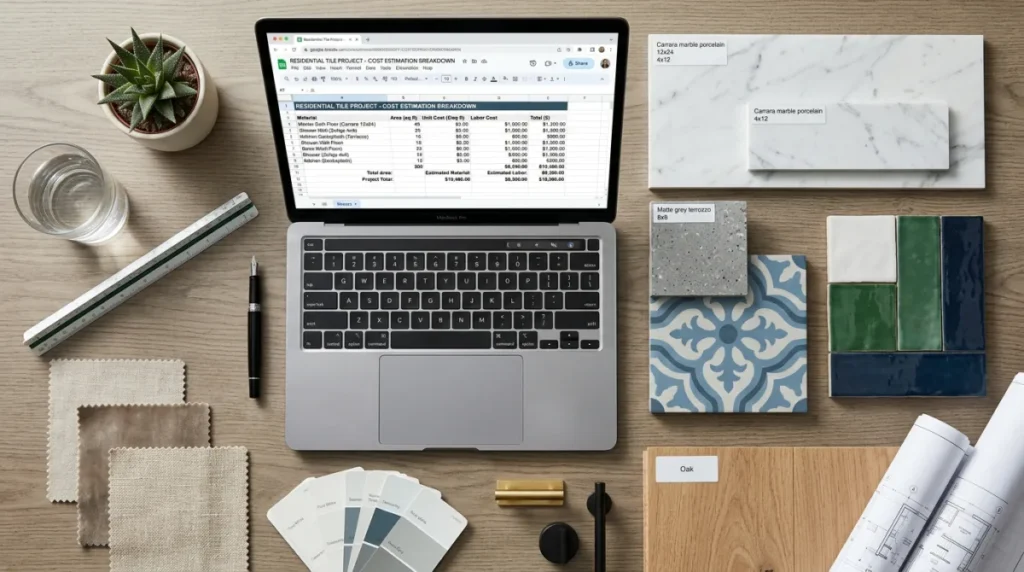
Your floor still needs to be installed. Include: Installation labour, adhesive, grout, surface preparation, and cutting work. A tile that looks cheaper can become more expensive once these costs are included.
5. Don't Forget Delivery
Add transportation and any other special costs, especially for large orders or long-distance delivery.
6. Compare the Total Project Cost
This is where smart buying begins. Don't ask only, “Which tile has the lowest price?” Ask: “Which option gives me the right quality, suitable performance and reasonable total cost for my project?” That is the difference between finding a cheap tile and finding good value.
Order Physical Tile Specification Box & Spec Sheets
Compare high-resolution digital glazes, body density, and calibrated finishes across ceramic and porcelain samples directly.
How Smart Buyers Compare Tile Prices
A tile quotation can look simple: design + quantity + price. But if you want to know whether you are getting a good deal, look a little deeper. Before accepting a quotation, check these points:
- Tile type: Is it ceramic, porcelain, vitrified or another type? Make sure it suits the space where you plan to use it.
- Size and thickness: Compare the exact size and thickness. A price comparison is meaningless if the products are not actually the same.
- Surface: Check whether it is matte, polished, textured or another finish. The surface can affect both appearance and cost.
- Quality and specifications: Don't judge quality from appearance alone. Check the relevant product specifications and agreed standards.
- Price unit: Is the price per piece, box, sq ft or sq m? Also check how much area each box covers.
- Quantity: Confirm the total quantity and whether extra tiles for cutting or breakage have been considered.
- Packaging: Ask what type of packaging and protection is included, especially for export orders.
- Delivery: Check whether transportation to your location is included or charged separately.
- FOB or CIF: For international purchases, understand exactly what the quoted Incoterm includes.
- Breakage policy: Ask what happens if tiles arrive damaged.
- Lead time: A low price is less useful if the order cannot arrive when your project needs it.
Most importantly, don't ask only: “What is your lowest price?” Ask: “What am I getting for this price?” That one question can change the way you compare tile suppliers.

The Cheapest Tile Is Not Always the Cheapest Choice
A lower price can look attractive at first. But the cheapest tile is not always the cheapest choice once you consider the complete project. Think beyond the number on the quotation:
- Price: Is the initial cost within your budget?
- Quality: Will the tile meet the needs of the space?
- Consistency: Will the full order match in colour, size and finish?
- Design: Does it suit the look you want?
- Performance: Can it handle the intended use and foot traffic?
- Packaging: Is it protected well enough to reach you safely?
- Logistics: What will delivery and transportation add to the cost?
- Installation: Will the tile require extra labour or preparation?
- Long-term value: Will it continue to perform well after years of use?
This is why comparing tile prices is not simply about finding the lowest number. When exploring a collection from a manufacturer such as Ramirro Ceramica, look at the complete product and project requirement, not just the initial quotation.
Final Takeaway — Look Beyond the Tile Price
The real cost of a tile goes beyond the box price. Raw materials, production, packaging, logistics, materials and installation, and tile installation cost all affect the final cost per square foot, which forms the true core of tile pricing economics for buyers. Your choice should also match the space, whether it is a bathroom, kitchen, living room, entryway, wet area, or low-traffic area.
Whether you buy online, offline, or through a wholesale supplier, compare durability, stain resistance, waterproof performance, design, and long-term value. From ceramic tile to high-quality porcelain with a natural stone look or realistic wood look, choose flooring that fits your needs and budget.
Use this cost guide and buying guide to look beyond the cheapest quotation. Explore the right Ramirro Ceramica collection, and contact the team for help choosing a suitable, high-value tile for your project.
Frequently Asked Questions (FAQs)
Why do tile prices vary so much?
Tile prices depend on materials, size, thickness, design, finish, quality, production, packaging, and logistics.
Does tile size affect its price?
Yes. Size can affect material use, production, handling, packaging, and transportation costs.
Does tile quality affect the cost?
Yes. Better materials, consistency, finish, performance, and quality control can increase the price.
What is the difference between FOB and CIF tile pricing?
FOB generally covers the goods up to loading at the agreed port. CIF includes cost, insurance, and freight to the named destination port.
How do I calculate the true cost of a tile floor?
Add tile material, wastage, installation, adhesive, grout, delivery, preparation, and other project costs.
Is the cheapest tile always the best option?
No. Compare the total project cost, quality, performance, and long-term value, not just the initial price.
Calculate Commercial FCL Container Landed Cost
Get precise container payload calculations, sea freight rates, and volume discounts on porcelain tile shipments from Morbi.
Shop Now | Chat With Expert | View Catalogue

Here’s what you get out of our article. Our team have various Ceramic Experts with experience of more than 25 Years, researches on problems our customer faces in tiling industry.
Ramirro Ceramica, – One of The Leading Tiles Manufacturer and Supplier globally, helps you people gain knowledgeable insight before making your purchase decision for products related to the floor and wall tiles.
So, we have closely monitored all kinds of trends in the ceramic tiles manufacturing world, from the old days of clay and plain color to modern digital, realistic-looking designs printed on ceramics with high-depth effects.
Our tiling Experts have seen thousands of different tiles patterns, sizes, materials, pricing, and installation techniques throughout their career.
Their expertise shared with you in simplified and organised way, helps you choose and make better decision before purchasing any flooring option available in market.
Brief about Company:
Ramirro is one of the finest Tiles manufacturers in India manufacturing porcelain and ceramic tiles. Our products have a variety of sizes and types of tiles ranging from Ceramics, porcelain, Full body etc. This helps you choose the perfect fit for your project. Plus, our collection will help you get inspiration from the architect’s design.
Here’s some more helpful links that showcase our users trust on Ramirro Ceramica Brand:
– Growth in International Market
– Trusted and Licensed Exporter
– Manufacturing Plant in India
Here’s our social proof by LinkedIn competing with top known global tiling brands: