Tile Packaging, Breakage & Logistics Vulnerability Calculator
Assess whether your export packaging, pallet strapping, and container weight distribution prevent transit breakage during ocean transport.
1. What pallet protection specifications are used for your export container shipments?
Table of Contents: Tile Packaging, Breakage & Logistics: How to Pack, Ship and Transport Ceramic Tiles Without Damage
- PART 1 — TILE PACKAGING
- How Should Ceramic Tiles Be Packed for Safe Transport?
- Why Does Tile Size and Surface Matter in Packaging?
- What Should Buyers Look for in a Tile Pallet?
- Which Wood Is Used for Ceramic Tile Pallets?
- When Should Tile Packaging Be Customized?
- PART 2 — TILE BREAKAGE
- Where Does Tile Breakage Actually Happen?
- Poor Handling Can Turn Good Packaging Into Broken Tiles
- Why Pallet Stability Matters During Tile Transport
- How Do Humidity and Moisture Affect Long Distance Tile Shipping?
- PART 3 — TILE LOGISTICS
- Does the Destination Change How Ceramic Tiles Should Be Packed?
- ISPM 15, Fumigation and the Pallet Mark: What Should Buyers Check?
- How Does Freight Type Affect Tile Packaging?
- Before the Container Leaves: A Buyer’s Final Packaging Check
- What Should You Do If Tiles Arrive Broken?
- Final Thoughts — Protecting Tiles Is a Chain, Not a Single Box
- FAQs
Tile breakage is minimized when strong packaging is combined with proper palletizing, careful loading, safe transportation and controlled handling. A [ceramic tile](/product-category/location/living-room/) can leave the factory in perfect condition and still arrive with cracked corners, broken pieces or damaged boxes because it still has a long journey ahead.
Good tile packaging is the first line of protection, but it is only one part of the journey. The pallet, protective materials, loading method and handling during transport also play an important role in reducing tile breakage.
For buyers, understanding this process makes it easier to ask the right questions before shipment. From the right packing and pallet to safe shipping and logistics, every step matters when the goal is to receive ceramic tiles without unnecessary damage.
PART 1 — TILE PACKAGING
How Should Ceramic Tiles Be Packed for Safe Transport?
A tile box is the first protection between the ceramic tile and the outside environment. It should be strong enough for the tile’s weight and sized correctly so the pieces remain stable during handling.
Good packing should achieve three things:
- Hold the tiles securely without excessive pressure.
- Reduce unnecessary [movement](/large-format-big-slab-tiles-safe-handling-and-installation-tips-you-must-know-ramirro-ceramica-guide/) inside the box.
- [Protect edges](/tiles-trim/) and surfaces from impact or scratches.
Too much empty space can allow tiles to move and hit each other. Too much pressure can also create stress. Separators, pads or other suitable protection can be added when required, especially for polished or decorative tiles. The exact protection should match the tile type, box design and transport conditions.
A damaged box corner can indicate that the package has experienced an impact, but it does not automatically mean the tiles inside are broken.
Why Does Tile Size and Surface Matter in Packaging?
Different tile sizes, weights and surfaces can require different packaging approaches.
Packaging can depend on:
- Size and thickness of the tile
- Weight of each box
- Surface type, such as polished or decorative
- Number of tiles per box
- Handling method
- Transport distance
- Destination requirements
For large format tiles, the main concern is suitable support during lifting, stacking and transportation. Their larger dimensions can change how they need to be packed and handled.
What Should Buyers Look for in a Tile Pallet?
Once the tiles are packed, the boxes need a stable base for handling. A pallet supports the boxes and allows equipment such as forklifts to move the load.
Think of it as the foundation of the shipment. A suitable pallet should:
- Support the total tile weight.
- Keep the boxes stable.
- Distribute the load properly.
- Stay stable during loading, unloading and movement.
- Be free from significant damage.
The right pallet is not necessarily the strongest or most expensive one. It should be suitable for the tile load, handling system and transportation route.
Wooden Pallets
Widely used for tile shipments because they are practical and available in different designs and load capacities.
Check: wood condition, construction, load capacity and applicable export requirements.
Processed Wood Pallets
These may use materials such as plywood or other processed wood products. Their regulatory treatment can differ from solid wood packaging.
For example, certain processed wood materials are outside the scope of ISPM 15. The actual material and destination rules should always be checked.
Metal Pallets
Strong and reusable, making them useful for some industrial or repeated use shipping systems. However, they can be heavier and more expensive, so they may not be practical for every export shipment.
Which Wood Is Used for Ceramic Tile Pallets?
Pallet manufacturers may use pinewood, hardwood or other locally available wood, depending on availability, cost, strength and pallet design.
But don’t judge a pallet only by its wood species. Also consider:
- Board thickness
- Pallet construction
- Load distribution
- Overall condition
A well designed pallet made from suitable wood is more important than simply choosing one particular species.
When Should Tile Packaging Be Customized?
Standard packaging works for many orders, but some shipments need a custom packing solution. This may be required when the product or transportation conditions are different from normal.
Custom packaging can be useful for:
Request Technical Consultation & Factory Specifications
Contact our senior ceramic engineers for certified technical test reports, compliance files, and project guidance from Ramirro Ceramica.
- Large or unusual tile sizes
- Heavy products
- Different box quantities
- Polished or decorative surfaces
- Special project requirements
- Customer specific labels
- Long distance transportation
- Specific pallet dimensions
- Special handling needs
The box, internal protection or pallet arrangement can be adjusted during the packaging and fabrication process.
The goal is simple: use the right packaging for the actual tile and the journey it needs to make.
PART 2 — TILE BREAKAGE
Where Does Tile Breakage Actually Happen?
Tile breakage is not always caused by poor packaging. Damage can happen at several points along the [shipment journey](/our-journey/):
Factory → Packing → Palletizing → Loading → Transport → Unloading → Storage
For example, a correctly packed box can still be damaged by rough forklift handling. A strong pallet can become unstable if the weight is not distributed properly. Even a well prepared shipment can suffer breakage if boxes shift during transport.
This is why tile breakage is often a chain problem, not a single point problem. Every stage needs proper handling to keep the tiles protected from the factory to the final destination.
Poor Handling Can Turn Good Packaging Into Broken Tiles
Good packaging provides protection, but it cannot fully prevent damage caused by careless handling.
Tiles can break when:
- Boxes are dropped or dragged.
- Forklifts hit pallet corners.
- Pallets are pushed or pulled roughly.
- Loads are stacked unevenly.
- Pallets move excessively during handling.
The simple lesson is important: packaging protects the tile, but safe handling protects the packaging too.
A carefully packed shipment can still arrive damaged if boxes, pallets or containers are handled roughly during loading and unloading.
Why Pallet Stability Matters During Tile Transport
Once tile boxes are placed on a pallet, the entire load should remain stable during lifting and movement. Even weight distribution and secure stacking help reduce unnecessary movement.
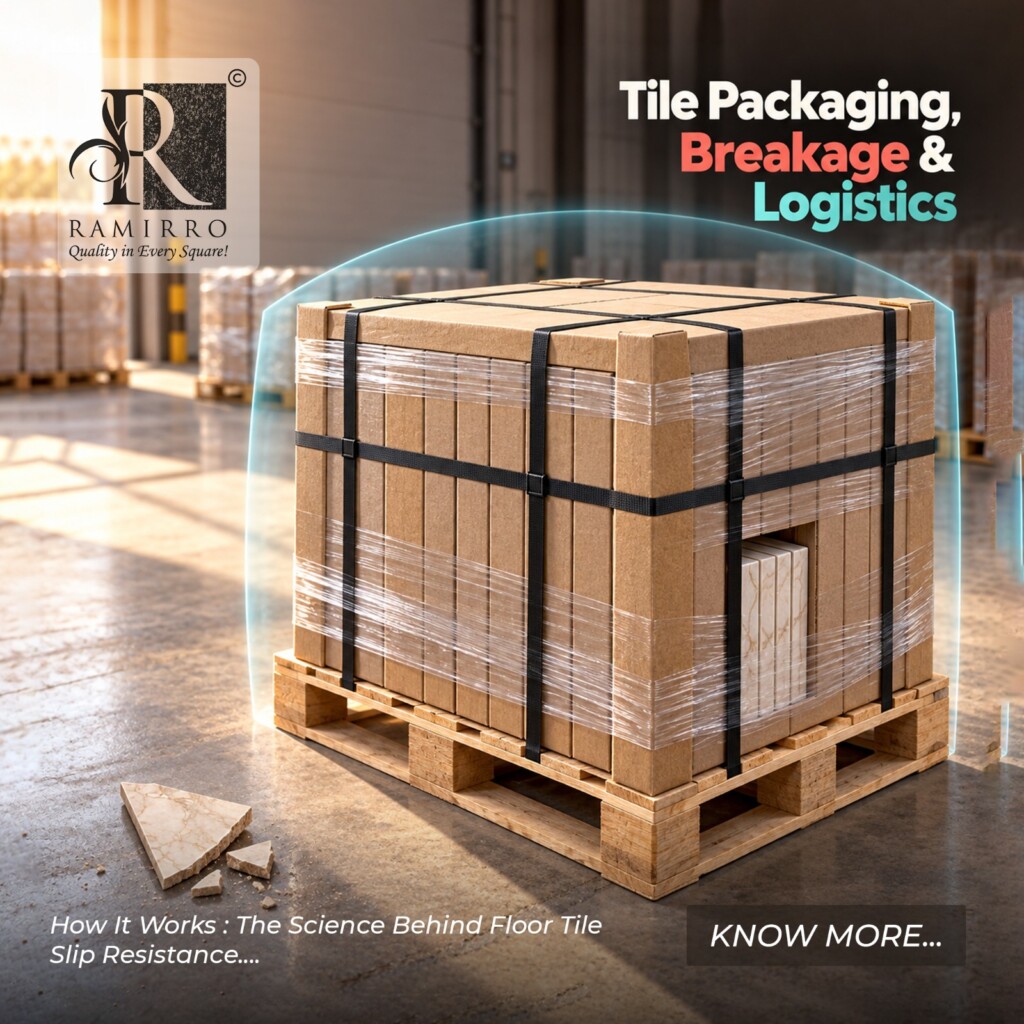
Strapping helps hold the boxes together as one stable load, while stretch wrapping helps secure the pallet and protect it during handling.
However, plastic wrapping cannot replace a properly designed pallet or strong cartons. The pallet, boxes, strapping and wrapping should work together as one stable packaging system.
How Do Humidity and Moisture Affect Long Distance Tile Shipping?
Long distance shipments, especially by sea, can experience changing humidity and moisture conditions. These conditions can affect cartons, pallets and other packaging materials if they are not properly protected.
Depending on the shipment and destination, desiccants or humidity absorbing materials may be used to help control moisture inside the cargo space.
The key point is simple: [humidity control](/how-to-waterproof-your-wall-floor-terrace-tiles-with-ramirro-ceramica-tiles/) supports the packaging and cargo environment, but it does not replace strong tile packaging. Not every tile shipment requires a humidity absorber; the need depends on the packaging, route, cargo conditions and shipping method.
PART 3 — TILE LOGISTICS
Does the Destination Change How Ceramic Tiles Should Be Packed?
There is no single packaging formula for every export destination. The right approach depends on the journey, climate, handling and local requirements.
Packaging may need to consider:
- Climate and humidity
- Sea or road transport
- Transit time
- Handling and storage
- Pallet requirements
- [Import regulations](/%E2%81%A0best-tile-import-business-tiles-showroom-setup-guide-for-importers/)
- Customer requirements
For hot or humid destinations, moisture protection may need more attention. For long sea shipments, stable pallets, secure wrapping and moisture management may need more attention.
Wood packaging rules can also differ by destination. For example, the EU requires qualifying wood packaging from non EU countries to meet ISPM 15 requirements, with exemptions for certain processed wood products such as plywood. The U.S. also has ISPM 15 requirements for regulated wood packaging, while Japan has its own plant quarantine requirements for wood packaging.
The key is to pack according to the actual destination and shipping conditions, not assumptions about a region.
ISPM 15, Fumigation and the Pallet Mark: What Should Buyers Check?
ISPM 15 is an international plant health standard for certain wood packaging materials used in international trade. It helps reduce the risk of pests being spread through materials such as qualifying wooden pallets and dunnage.
One important point: not every wooden pallet should simply be called “fumigated.” Depending on the applicable requirements, approved treatments can include heat treatment and certain fumigation treatments.
Before shipment, buyers should check:
- Does the pallet require ISPM 15 compliance?
- Is the correct ISPM 15 mark present?
- Is treatment proof or documentation required?
- Does the destination have any additional requirements?
Order Physical Architectural Sample Box
Inspect calibrated porcelain finishes, surface textures, and edge rectifications with an official Ramirro Ceramica sample kit.
If documentation is required, ask the supplier for the relevant treatment proof before shipment.
How Does Freight Type Affect Tile Packaging?
Packaging should also match the freight method.
Sea freight: Longer transit and repeated handling make stable palletization, wrapping and moisture considerations important.
Road transport: Loading, unloading, vibration and repeated handling can create impact risks.
Air freight: Weight and package dimensions become especially important because they can affect freight costs.
There is no single freight method that automatically causes more breakage. Each method simply creates different packaging priorities.
Before the Container Leaves: A Buyer’s Final Packaging Check
Before dispatch, a quick inspection can help catch problems while they are still at the factory.
Tile: Correct size, quantity and visible condition.
Box: Strong enough, properly fitted and without excessive empty space.
Protection: Suitable internal protection, corner protection and wrapping where required.
Pallet: Stable, properly loaded and compliant with destination requirements.
Shipment: Properly strapped, securely loaded to reduce movement, and photographed before dispatch.
A few checks before loading can be much easier than dealing with broken tiles after the shipment arrives.
What Should You Do If Tiles Arrive Broken?
If tiles arrive damaged, document the condition before disposing of packaging or moving damaged goods. Document the condition first, as this information can be useful when checking where the damage may have happened.
Take clear photos of the damaged pallets, boxes and broken tiles. Make sure box and pallet labels are visible so the shipment can be identified easily. Count the damaged boxes or tiles and compare the quantity with your packing and shipping records.
Then inform the supplier and logistics provider promptly and keep the damaged packaging until the issue is checked. Photos, labels, quantities and packaging condition can provide useful evidence for an inspection or damage claim.
Final Thoughts — Protecting Tiles Is a Chain, Not a Single Box
A successful tile shipment depends on more than a strong box. Tiles are fragile, and reducing the risk of damage requires proper packaging, stable palletizing, careful container loading and reliable shipping. From porcelain tile, vitrified tiles and wall tiles to floor tiles, bathroom tiles and large-format tiles, different [types of tiles](/7-types-of-tiles-textures-surface-finishes-porcelain-ceramic-tiles/) may need different protection. Using suitable edge protectors, corrugate, bubble wrap or a heavy-duty packaging solution where required can support safer handling and delivery.
For tile manufacturers and buyers involved in international shipping, choosing the right packaging and following packaging standards can help reduce breakage during transportation. Whether you are importing tiles or buying a [collection](https://www.ramirro.com/shop/) [online](https://www.ramirro.com) or offline, consider the packaging and shipping process as carefully as the tile itself. For safe delivery, ask about available collections, packaging options and destination requirements, and [contact Ramirro Ceramica](https://www.ramirro.com/morbi-tiles-factory-contact-number/) to discuss the right solution for your shipment.
FAQs
What is the best packaging for ceramic tiles?
The right packaging depends on tile size, weight, surface, quantity, transport method and destination.
Why do tiles break during shipping?
Breakage can result from impact, movement, weak packaging, unstable pallets, poor loading or rough handling.
Which pallet is best for tile shipping?
It depends on the load, handling system, freight method and destination requirements. Wooden, processed wood and metal pallets can all have different uses.
Does every wooden pallet need fumigation?
No. The applicable requirement depends on the type of wood packaging and destination. ISPM 15 includes approved treatments and exemptions.
What is ISPM 15?
It is an international plant health standard for certain raw wood packaging used in international trade.
Should [ceramic tile](/tiles-in-ghana/) boxes have empty space?
Excessive empty space can allow movement and impact. Packaging should hold the tiles securely without creating unnecessary pressure.
Do different countries need different tile packaging?
Packaging may need to change according to destination climate, freight route, handling, customer requirements and import regulations.
Get Factory-Direct B2B Container Quote
Receive fast FOB or CIF quotations for export-grade porcelain and ceramic tiles shipped directly from Morbi, India.
Shop Now | Chat With Expert | View Catalogue

Here’s what you get out of our article. Our team have various Ceramic Experts with experience of more than 25 Years, researches on problems our customer faces in tiling industry.
Ramirro Ceramica, – One of The Leading Tiles Manufacturer and Supplier globally, helps you people gain knowledgeable insight before making your purchase decision for products related to the floor and wall tiles.
So, we have closely monitored all kinds of trends in the ceramic tiles manufacturing world, from the old days of clay and plain color to modern digital, realistic-looking designs printed on ceramics with high-depth effects.
Our tiling Experts have seen thousands of different tiles patterns, sizes, materials, pricing, and installation techniques throughout their career.
Their expertise shared with you in simplified and organised way, helps you choose and make better decision before purchasing any flooring option available in market.
Brief about Company:
Ramirro is one of the finest Tiles manufacturers in India manufacturing porcelain and ceramic tiles. Our products have a variety of sizes and types of tiles ranging from Ceramics, porcelain, Full body etc. This helps you choose the perfect fit for your project. Plus, our collection will help you get inspiration from the architect’s design.
Here’s some more helpful links that showcase our users trust on Ramirro Ceramica Brand:
– Growth in International Market
– Trusted and Licensed Exporter
– Manufacturing Plant in India
Here’s our social proof by LinkedIn competing with top known global tiling brands: