
Outdoor Tile Drainage Risk & Slope Evaluator
Identify water pooling risks, slope defects, and drainage errors before tiling your patio or exterior terrace.
1. What is the surface slope (fall) planned for your outdoor tiled patio?
Table of Contents: Same for this: # Drainage Planning Mistakes in Outdoor Tiling: Common Problems and How to Avoid Them
- A Beautiful Patio Can Still Have a Water Problem
- Mistake #1: Choosing Tiles Before Planning Drainage
- Mistake #2: Getting the Slope Wrong
- Mistake #3: Thinking a Drain Automatically Solves the Problem
- Mistake #4: Forgetting the Building Around the Tiles
- Mistake #5: Replacing Old Tiles Without Fixing the Real Problem
- Choosing Outdoor Tiles With Drainage in Mind
- The Bigger Picture: Good Drainage Protects More Than Your Tiles
- What Drainage Has to Do With the Future of Sustainable Tiles
- Before You Tile: A 7 Point Drainage Check
- Final Thoughts — Don’t Just Ask “Which Tile?” Ask “Where Will the Water Go?”
The most common outdoor tiling drainage mistakes are poor slope, badly placed drains, blocked drainage paths, and water flowing toward the building. Planning the water flow before installation can prevent most of these problems.
Good drainage helps prevent standing water and protects more than the tiles. It can also reduce moisture related damage to grout, waterproofing, walls, and other parts of the building.
As sustainable tiles become more important, long term performance matters too. The right tile, proper installation, and effective drainage can help create an outdoor surface that lasts longer and needs fewer repairs.
A Beautiful Patio Can Still Have a Water Problem
A patio can look perfect when the tiles are first installed, yet still have a drainage problem. If the surface has poor slope or the drains are badly placed, rainwater can collect near walls, doorways, or corners.
Outdoor tiling is not just about choosing a tile that looks good. Water movement must be planned before installation so rainwater can leave the surface without creating new problems.
Poor drainage can affect more than the tiles. Continued moisture may damage grout, waterproofing, walls, and other parts of the building, making proper drainage an important part of the building’s long term health.
Mistake #1: Choosing Tiles Before Planning Drainage
Most patio projects start with the tile.
“Which colour looks better?”
“Should I choose large tiles?”
“Is this finish worth the extra cost?”
These are useful questions — but they are not the first questions you should ask.
Start with one question: Where will the water go?
That answer should guide the rest of the plan. The slope of the surface, position of the drains, [tile layout](/web-stories/types-of-tiles-layout-pattern/), and even the area around the building all need to work with the natural flow of rainwater.
Here is what can go wrong:
You install beautiful tiles, finish the patio, and wait for the first heavy rain. The water slowly moves toward the back door instead of away from the house.
The tiles are not necessarily the problem. The drainage plan was.
Before choosing your tiles, check:
- Where does rainwater naturally collect?
- Which direction should it flow?
- Where will the water leave the patio?
- Are doors and walls safely away from the main water path?
Choose the tile after you understand the water — not the other way around.
Mistake #2: Getting the Slope Wrong
Here is a simple way to think about slope or fall: it is a slight angle that gives water a direction to move. Outdoor tiles should not behave like a perfectly flat table. Rainwater needs a clear path away from the surface.
What happens when the slope is wrong?
- Too little slope: Water sits on the tiles and forms puddles.
- Slope toward the house: Rainwater moves toward doors, walls, or other vulnerable areas.
- Uneven slope: Water collects in random low spots instead of reaching the drain.
And there is one important point: the tile cannot correct a badly prepared base. If the surface underneath is flat or slopes the wrong way, laying a beautiful new tile over it will not solve the problem.
Quick check
After the next rainfall, look at your patio:
Does the water move away quickly — or does it keep returning to the same spots?
Request Technical Consultation & Factory Specifications
Contact our senior ceramic engineers for certified technical test reports, compliance files, and project guidance from Ramirro Ceramica.
The exact slope needed depends on the size of the area, tile format, drainage system, and overall construction. So there is no single slope number that works for every outdoor project.
Mistake #3: Thinking a Drain Automatically Solves the Problem
Adding a drain to a patio may sound like the easiest solution to [water problems](/how-to-waterproof-your-wall-floor-terrace-tiles-with-ramirro-ceramica-tiles/). But a drain only works when water can actually reach it.
Think of it like a road. If the road does not lead to the destination, having a destination does not help. The same applies to drainage. The drain should sit at a suitable low point, handle the amount of water expected, and remain easy to clean.
Two common options
- Floor drain: A small drain set into the floor that collects water at a low point.
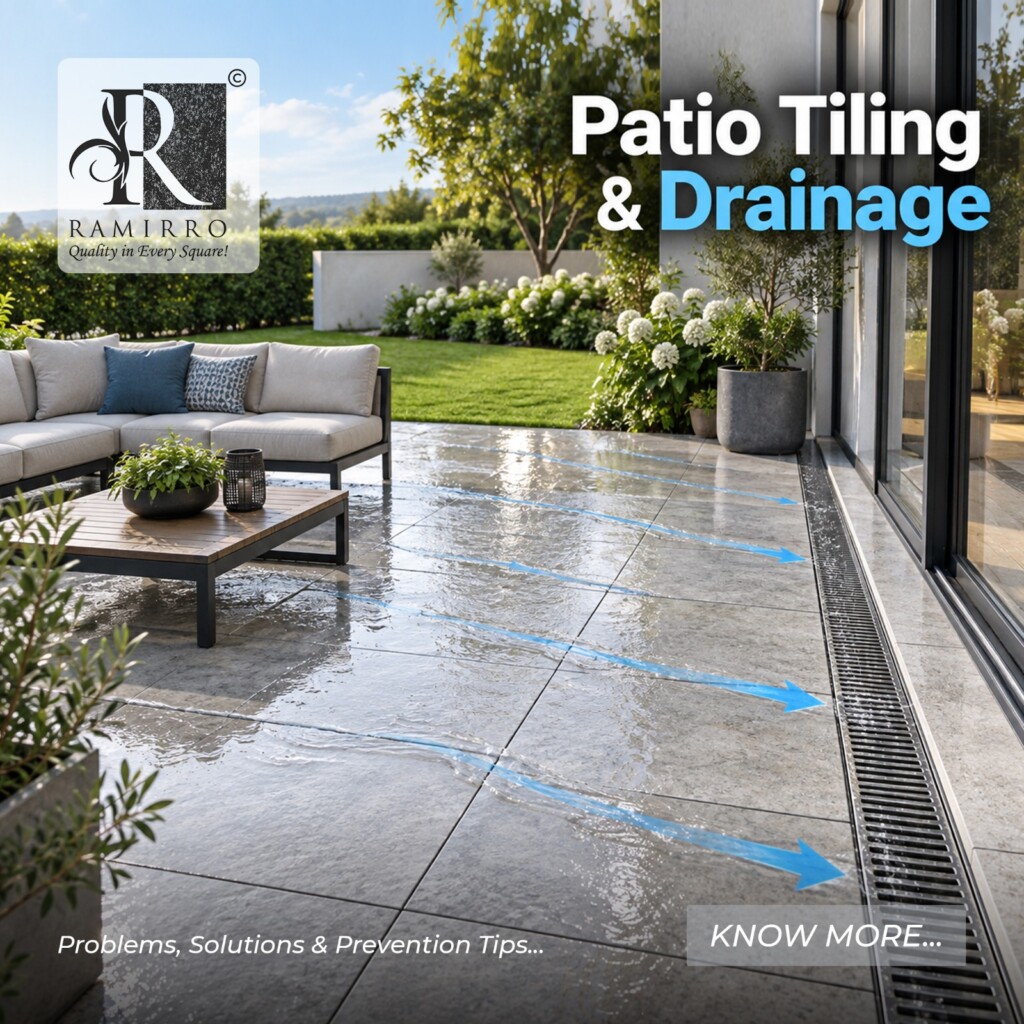
- Linear or channel drain: A longer, narrow drain that collects water along a line. It can work well along doorways, walls, or the edge of a patio.
Even a good drain can fail if leaves, dirt, or debris block it or if the surrounding surface sends water somewhere else.
The key takeaway: A drain needs a path.
Mistake #4: Forgetting the Building Around the Tiles
Outdoor tiles do not exist on their own. They meet doors, walls, steps, balconies, and building edges, and these areas need just as much attention as the tiled surface.
One common mistake is allowing rainwater to collect beside a wall or doorway. Another is letting a roof downpipe discharge directly onto the tiled area without a proper route for the water. When moisture stays in these places for too long, it can create problems for finishes and other vulnerable parts of the building.
Think Beyond the Tile
Poor water management → standing moisture → damage to vulnerable areas → more repairs.
And remember: tiles are not waterproofing. A tile may resist water, but the complete outdoor system still needs proper drainage and, where required, suitable waterproofing to protect the building.
Mistake #5: Replacing Old Tiles Without Fixing the Real Problem
Seeing cracked or worn out patio tiles often makes the solution seem obvious: remove them and install new ones. But what if the puddles return after the renovation?
That usually means the real problem was never the tile. The underlying slope may still be wrong, the drainage route may still be poor, or the base may not have been prepared properly.
Before replacing an old outdoor surface, find out why it failed in the first place. Check where water collects, how it leaves the area, and whether the surface underneath needs correction.
New tiles can hide a drainage problem, but they cannot solve one underneath them.
Choosing Outdoor Tiles With Drainage in Mind
Once the drainage plan is clear, then choose the tile. Outdoor tiles have to deal with rain, moisture, dirt, temperature changes, and regular foot traffic, so appearance should not be the only deciding factor.
A few simple terms can help:
- [Water absorption](/quality-control/): how much water a tile can take in. Lower absorption is generally important for outdoor applications exposed to moisture.
- [Slip resistance](/new-presa-series-anti-skid-anti-slip-tiles/): how much grip the tile provides when wet. A tile that looks great but becomes slippery in rain is not a good choice for many outdoor areas.
- Porcelain: a dense type of ceramic tile that has very low water absorption and is widely used in outdoor applications.
The right choice also depends on where the tile will be installed. A covered balcony, open patio, poolside area, and terrace may all have different needs.
Before You Buy, Ask
- Is this tile suitable for my outdoor space?
- How does it perform when wet?
- Is it suitable for my local climate?
- What installation method is recommended?
- What does the manufacturer specify for this application?
Good outdoor tile selection is not just about what looks good. It is about what will continue to perform when the weather changes.
The Bigger Picture: Good Drainage Protects More Than Your Tiles
Good drainage is not just about keeping puddles off your patio. It helps protect the entire outdoor area from the tiles and [grout](/a-to-z-tile-glossary-quick-guide-to-technical-ceramic-tile-terms/) to nearby walls, edges, and waterproofing.
When water moves away as planned, it spends less time sitting on the surface or against the building. This can help reduce moisture related problems and keep the outdoor space in better condition for longer.
Order Physical Architectural Sample Box
Inspect calibrated porcelain finishes, surface textures, and edge rectifications with an official Ramirro Ceramica sample kit.
Think of it as a simple chain:
Good planning → better water flow → less standing water → fewer moisture problems → longer lasting outdoor surface.
And that last point matters. A surface that lasts longer may need fewer repairs and replacements, which is an important part of thinking about more sustainable outdoor tiling.
What Drainage Has to Do With the Future of Sustainable Tiles
A sustainable tile is not only about how it is manufactured. It is also about how long it remains useful.
A well planned outdoor installation can last longer and reduce the need for early repairs or replacement. That means less wasted material and better use of the resources already put into the project.
This is where drainage becomes part of the bigger sustainability [picture](/7-types-of-tiles-textures-surface-finishes-porcelain-ceramic-tiles/). The right tile, efficient manufacturing, durable [materials](/tiles-adhesive-types/), smart installation, and good water management all work together.
Sustainability starts with the tile, but it does not end there.
Before You Tile: A 7 Point Drainage Check
Before the first tile goes down, take a few minutes to check the space. A simple drainage check now can save you from expensive repairs later.
1. Where does rainwater collect?
Look for existing puddles and low spots.
2. Which direction should water flow?
Make sure water has a clear route away from the building.
3. Is the surface properly sloped?
The surface should have enough fall to move water toward the planned drainage point.
4. Where will the water leave?
Check the position of the drain, channel, or other drainage outlet.
5. Are doors and walls protected?
Make sure water is not directed toward entrances, walls, or other vulnerable areas.
6. Is the tile suitable for the location?
Check its outdoor suitability, water absorption, and grip when wet.
7. Have existing problems been fixed?
If the old patio had drainage issues, solve the cause before installing new tiles.
One final question: If heavy rain falls tomorrow, can you clearly show the path the water will take? If not, the drainage plan needs more attention before tiling begins.
Final Thoughts — Don’t Just Ask “Which Tile?” Ask “Where Will the Water Go?”
Outdoor tiling is about more than design. A well planned tile system should help allow water to move away from your garden, patio, or exterior space. The right tile drainage system, drain pipe, and installation can reduce water pooling, wet spots, and the risk of water damage during [heavy rainfall](/best-extreme-weatherproof-tiles/).
The tile itself is only one part of the solution. Whether you choose a [porcelain tile](/fabulous-ways-glossy-and-matt-porcelain-tiles-can-make-your-living-space-look-like-a-million-bucks/), clay tile, or outdoor porcelain pavers, consider your site’s requirements, drainage pipe, drain depth, and overall drain system. Good planning and regular maintenance can help prevent excess water, mold and mildew, and costly problems caused by poor installation.
As the industry moves toward more eco friendly choices, durability matters too. A longer lasting outdoor surface can mean fewer replacements and less waste. [Explore Ramirro Ceramica’s collection](https://www.ramirro.com/shop/) [online](https://www.ramirro.com) or offline, and [contact us](https://www.ramirro.com/morbi-tiles-factory-contact-number/) if you need help choosing the right tiles and drainage solutions for your project.
The [best outdoor tile](/product/jasto-blue/) installation is not the one that only looks good on a sunny day. It is the one that continues to perform when the rain arrives.
Get Factory-Direct B2B Container Quote
Receive fast FOB or CIF quotations for export-grade porcelain and ceramic tiles shipped directly from Morbi, India.
Shop Now | Chat With Expert | View Catalogue

Here’s what you get out of our article. Our team have various Ceramic Experts with experience of more than 25 Years, researches on problems our customer faces in tiling industry.
Ramirro Ceramica, – One of The Leading Tiles Manufacturer and Supplier globally, helps you people gain knowledgeable insight before making your purchase decision for products related to the floor and wall tiles.
So, we have closely monitored all kinds of trends in the ceramic tiles manufacturing world, from the old days of clay and plain color to modern digital, realistic-looking designs printed on ceramics with high-depth effects.
Our tiling Experts have seen thousands of different tiles patterns, sizes, materials, pricing, and installation techniques throughout their career.
Their expertise shared with you in simplified and organised way, helps you choose and make better decision before purchasing any flooring option available in market.
Brief about Company:
Ramirro is one of the finest Tiles manufacturers in India manufacturing porcelain and ceramic tiles. Our products have a variety of sizes and types of tiles ranging from Ceramics, porcelain, Full body etc. This helps you choose the perfect fit for your project. Plus, our collection will help you get inspiration from the architect’s design.
Here’s some more helpful links that showcase our users trust on Ramirro Ceramica Brand:
– Growth in International Market
– Trusted and Licensed Exporter
– Manufacturing Plant in India
Here’s our social proof by LinkedIn competing with top known global tiling brands: