
Understanding why indian tiles fail in western markets is essential for international tile importers, developers, and Indian manufacturers aiming for sustained global success. Some Indian tiles struggle in Western markets because of batch inconsistency, missing certifications, and failure to meet required quality standards. A tile may look premium, but small differences in size, shade, water absorption, or performance can create problems for international buyers.
Markets such as Europe, the UK, the USA, Canada, and Australia often have strict expectations for tile quality, testing, certification, packaging, and product documentation. Meeting these requirements consistently is just as important as design and price. This does not mean Indian tiles are low quality. India has a strong ceramic tile industry, but successful tile export depends on producing the right quality for the destination market and proving that quality with proper testing and documentation.
Western Market Compliance & Quality Readiness Test
Evaluate your tile specification, test documentation, and batch consistency to understand why indian tiles fail in western markets and how to succeed.
1. What is your destination market and regulatory standard?
Table of Contents
- Are Indian Tiles Really Lower Quality?
- The “Looks Perfect” Trap: Problems You May Not See in a Tile Sample
- The Water Test That Can Change How a Tile Is Classified
- Europe, The UK and The USA Do Not Speak Exactly The Same “Tile Language”
- “Send Me Your Test Report” — The Question That Exposes Weak Exporters
- A Tile Can Pass the Factory and Still Fail at the Project
- The Container Arrived Safely—But Did the Tiles?
- The Label on the Box Matters More Than Many Exporters Think
- The Price Trap: When the Cheapest Tile Becomes the Most Expensive
- Why Western Importers May Reject a Tile That Sells Well Elsewhere
- Sustainability Is Moving From Marketing to Documentation
- Importer Checklist: 12 Questions to Ask Before Buying Indian Tiles
- Manufacturer Checklist: What to Fix Before Targeting Western Markets
- How Ramirro Ceramica Eliminates Why Indian Tiles Fail in Western Markets
Are Indian Tiles Really Lower Quality?
No. India has a massive ceramic tile industry centered in Morbi, Gujarat, producing everything from budget tiles for developing markets to premium, export-grade porcelain slabs matching Italian and Spanish technical benchmarks. The real issue behind why indian tiles fail in western markets is not nationality; it is about matching the right product with the right standard, the right market, and maintaining consistent production discipline.
Why Two Indian Tile Factories Can Produce Different Results
Tile quality varies dramatically because factories use different raw materials, press tonnage, firing temperatures, glazing formulations, calibration machinery, sorting sensors, and packaging standards. A low-cost tile engineered for domestic price sensitivity will inevitably fail if exported to an EU commercial project requiring strict EN 14411 compliance.
Export Quality Is More Than a Premium Looking Surface
Marble designs, glossy finishes, and attractive digital printing can make a tile look premium, but appearance alone does not prove quality. Western buyers rigorously verify dimensional accuracy, water absorption, breaking strength, surface abrasion resistance (PEI), and batch shade consistency.
The “Looks Perfect” Trap: Problems You May Not See in a Tile Sample
Small Size Differences Become Big Installation Problems
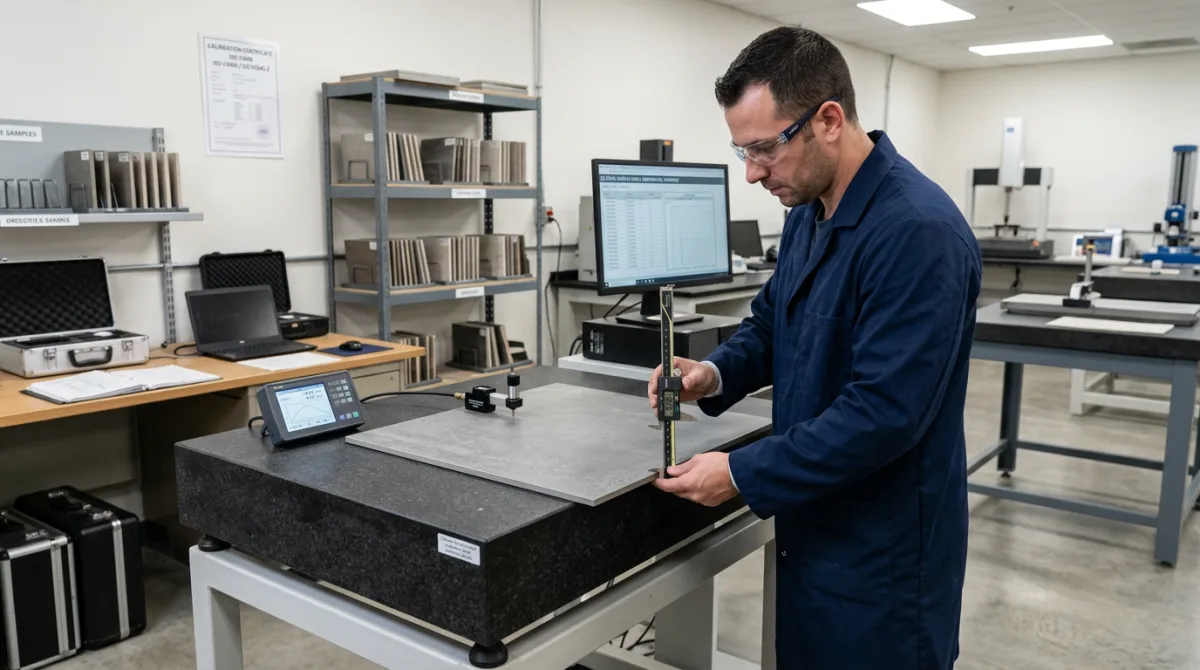
Dimensional accuracy defines how closely each tile matches its nominal dimensions. Differences in length, width, thickness, squareness, or edge straightness make installation frustrating. Strict tile size tolerance is mandatory under international standards; even a 0.5 mm deviation across a 600×1200 mm rectified tile creates crooked, jagged grout lines that architects will immediately reject.
Why Flatness Matters More With Larger Tiles
Warpage occurs when a tile cures with a slight curve instead of perfect flatness. On large porcelain tiles, even minimal center curvature creates noticeable lippage between adjacent tiles, making it impossible for installers to deliver the smooth, flat floor expected in Western homes.
Same Design, Different Shade
While intentional shade variation adds natural character, unwanted batch variation is fatal to project success. A soft grey sample that arrives as a warm yellowish grey in the container, followed by a third shade in the re-order, leads to project shutdowns and warranty lawsuits.
📥 Download the Western Market Export Quality Compliance Guide
Learn how Ramirro Ceramica guarantees EN 14411, CE DoP, and ASTM C373 compliance with batch-matched lab certificates and zero-defect export packaging.
The Water Test That Can Change How a Tile Is Classified
What Does Tile Water Absorption Mean?
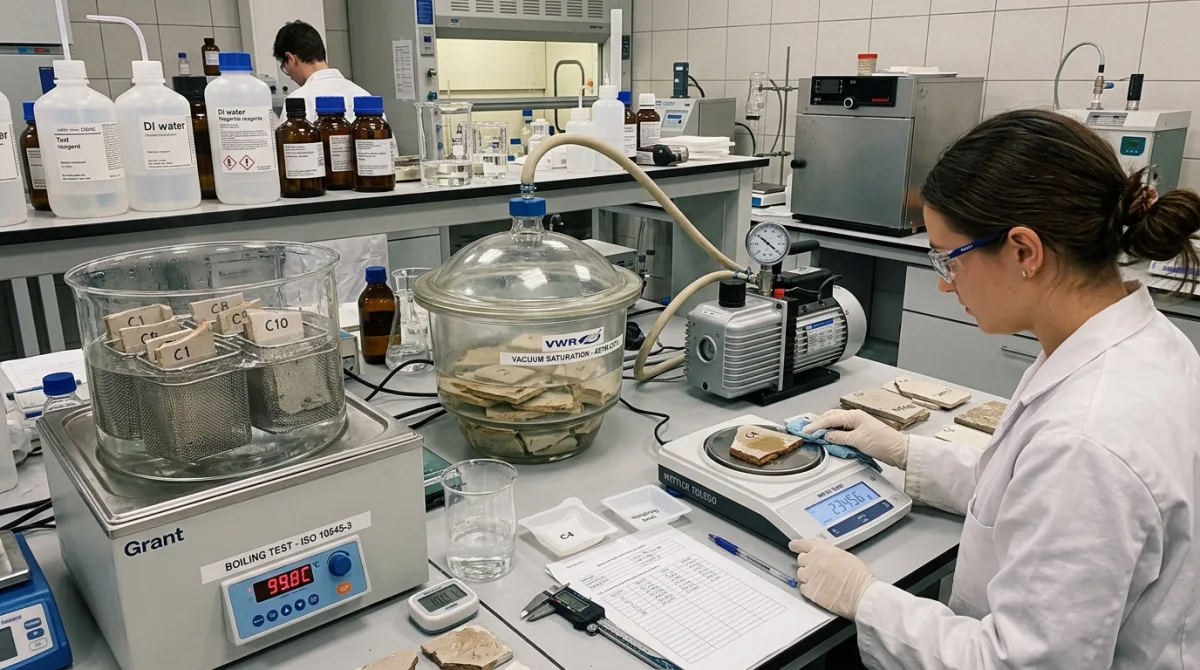
Water absorption dictates tile vitrification and frost resistance. Under standardized test methods like ISO 10545-3 and ASTM C373, tiles are weighed dry, subjected to boiling or vacuum saturation, and weighed again to measure water intake percentage.
Ceramic, Porcelain and Vitrified Are Not Interchangeable Words
A frequent reason why indian tiles fail in western markets is terminology confusion. In India, “vitrified” is a common term for dense tiles. But in Europe and the USA, “porcelain” is legally defined by an absorption rate of ≤ 0.5% (ISO 13006 Group BIa). If a tile labeled as porcelain absorbs 1.5% or 2.0% water, it fails customs checks, cracks under freeze-thaw cycles, and exposes importers to legal liability.
Europe, The UK and The USA Do Not Speak Exactly The Same “Tile Language”
There is no universal “export certificate.” Western markets apply distinct technical frameworks:
- European Union: Requires EN 14411 compliance, CE marking, and an official Declaration of Performance (DoP) linked to traceable third-party laboratory test reports.
- United Kingdom: Regulated post-Brexit under UKCA and specific national British Standards (BS EN 14411).
- United States: Governed by ANSI A137.1 specifications, ASTM test protocols, and ANSI A326.3 dynamic coefficient of friction (DCOF) standards.
- Australia & Canada: Require AS 4586 slip resistance ratings and national building code adherence.
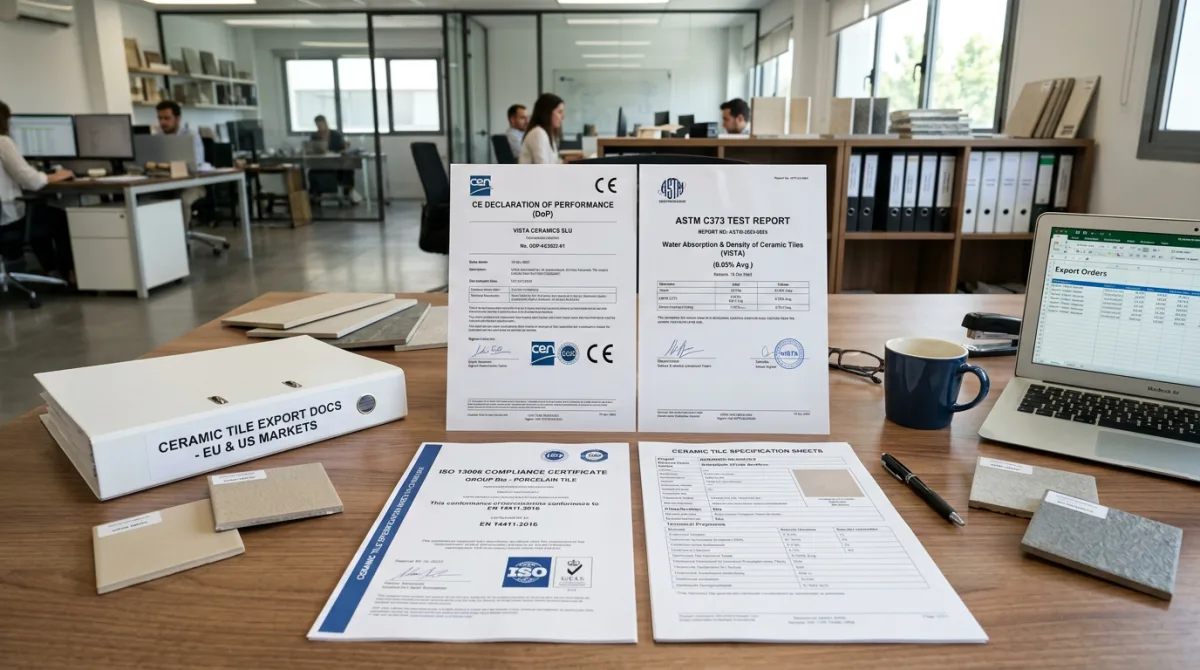
“Send Me Your Test Report” — The Question That Exposes Weak Exporters
When an experienced Western importer asks for a test report, weak exporters often supply a photocopied, generic catalog test from several years ago. A legitimate test report must apply to the exact tile, finish, caliber, and production batch being purchased. Always confirm the laboratory accreditation, test dates, and parameter thresholds before committing to a container.
🧪 Request Batch-Certified Physical Tile Sample Kits
Test Ramirro Ceramica’s rectified porcelain tiles in your own lab. Verify dimensional tolerance, zero warpage, and certified ≤ 0.5% water absorption.
A Tile Can Pass the Factory and Still Fail at the Project
Not every customer complaint originates in manufacturing. Selling polished porcelain for exterior freeze-thaw zones or specifying wall tiles for heavy commercial floors results in rapid failure. Clarifying application suitability, recommending suitable polymer-modified adhesives, and requiring licensed tile contractors prevents false warranty claims.
The Container Arrived Safely—But Did the Tiles?
A major reason why indian tiles fail in western markets is export packaging negligence. Weak cartons, absent corner buffers, flimsy pallets that collapse under forklift handling, and lack of container dunnage result in thousands of dollars in transit breakage. Packaging must match tile format and weight.
The Label on the Box Matters More Than Many Exporters Think
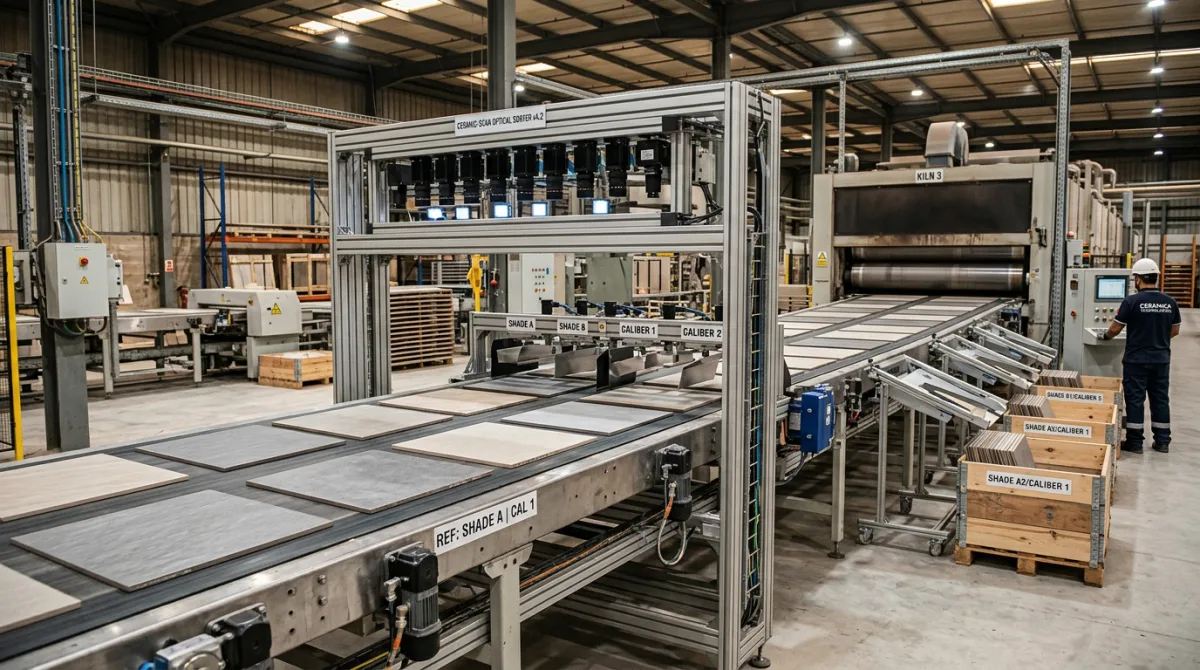
Accurate box labeling is non-negotiable in Western logistics. Cartons must clearly display nominal size, work size (caliber), shade/batch code, total square meters, barcode, country of origin, and certified regulatory marks (such as CE or UKCA). Missing caliber or shade data creates inventory chaos in destination distributor warehouses.
The Price Trap: When the Cheapest Tile Becomes the Most Expensive
Saving $0.50 per square meter on an uncertified supplier quickly transforms into catastrophic losses when an entire container is held at customs, rejected by the contractor for size lippage, or fractured by frost. Smart buyers calculate the landed cost of quality, factoring in sorting, reliable testing, and zero-breakage packaging.
Why Western Importers May Reject a Tile That Sells Well Elsewhere
Western distributors face strict consumer protection laws and liability for contractor installation downtime. They cannot afford to gamble on suppliers that lack traceable batch quality, consistent shade reproduction, and certified slip-resistance data.
Sustainability Is Moving From Marketing to Documentation
Vague claims like “eco-friendly” no longer convince Western commercial architects. Leading European and North American projects require certified Environmental Product Declarations (EPD), verified recycled content percentages, and documented kiln energy metrics for LEED and BREEAM green building certifications.
Importer Checklist: 12 Questions to Ask Before Buying Indian Tiles
- Which specific international standard (ISO 13006, EN 14411, ANSI A137.1) is this tile certified under?
- Can you provide a batch-matched laboratory test report from an accredited testing institute?
- What is the tested water absorption percentage? (Is it verified ≤ 0.5% for porcelain?)
- What are the exact dimensional tolerances and warpage limits?
- How does your facility optically control and mark shade and caliber on every box?
- What pre-shipment quality control (PSI) protocols are implemented before container stuffing?
- Is the tile certified for my specific residential or commercial application?
- What slip resistance metrics (DCOF, PTV, or R-rating) are documented?
- Do your wooden pallets comply with ISPM 15 heat treatment regulations?
- What specific marks (CE, UKCA) and barcode labels are printed on export cartons?
- What is your documented policy on transit breakage and batch replacement?
- Can you provide technical EPD or sustainability documentation if required?
Manufacturer Checklist: What to Fix Before Targeting Western Markets
To overcome the obstacles of why indian tiles fail in western markets, manufacturers must align their operations: calibrate press dies, invest in automated optical sorting lines, partner with accredited testing laboratories, enforce ISPM 15 wooden pallet standards, and maintain transparent batch records.
💼 Source Western-Compliant Porcelain Tiles from Ramirro Ceramica
Ramirro Ceramica sets the standard for Morbi tile exports with 100% automated optical inspection, certified CE/ISO test reports, zero-breakage container packaging, and reliable batch matching.
How Ramirro Ceramica Eliminates Why Indian Tiles Fail in Western Markets
Ramirro Ceramica bridges the gap between Indian manufacturing cost advantages and strict Western quality expectations. By enforcing Italian quality management systems, automated surface scanning, verified ≤ 0.5% water absorption, and heavy-duty ISPM 15 crate logistics, Ramirro delivers dependable porcelain surfaces worldwide.
Explore Ramirro Ceramica’s premium tile collection through online and offline purchase options. Contact the technical export team to discuss product quality, testing reports, and custom container specifications for your market.
Watch our Video:
Shop Now | Chat With Expert | View Catalogue

Here’s what you get out of our article. Our team have various Ceramic Experts with experience of more than 25 Years, researches on problems our customer faces in tiling industry.
Ramirro Ceramica, – One of The Leading Tiles Manufacturer and Supplier globally, helps you people gain knowledgeable insight before making your purchase decision for products related to the floor and wall tiles.
So, we have closely monitored all kinds of trends in the ceramic tiles manufacturing world, from the old days of clay and plain color to modern digital, realistic-looking designs printed on ceramics with high-depth effects.
Our tiling Experts have seen thousands of different tiles patterns, sizes, materials, pricing, and installation techniques throughout their career.
Their expertise shared with you in simplified and organised way, helps you choose and make better decision before purchasing any flooring option available in market.
Brief about Company:
Ramirro is one of the finest Tiles manufacturers in India manufacturing porcelain and ceramic tiles. Our products have a variety of sizes and types of tiles ranging from Ceramics, porcelain, Full body etc. This helps you choose the perfect fit for your project. Plus, our collection will help you get inspiration from the architect’s design.
Here’s some more helpful links that showcase our users trust on Ramirro Ceramica Brand:
– Growth in International Market
– Trusted and Licensed Exporter
– Manufacturing Plant in India
Here’s our social proof by LinkedIn competing with top known global tiling brands: